Corporate Ownership, Digital Technologies, and Accreditation:
Key Topics at the UEVP General Assembly in Rovaniemi
11 June 2026, Rovaniemi, Finland

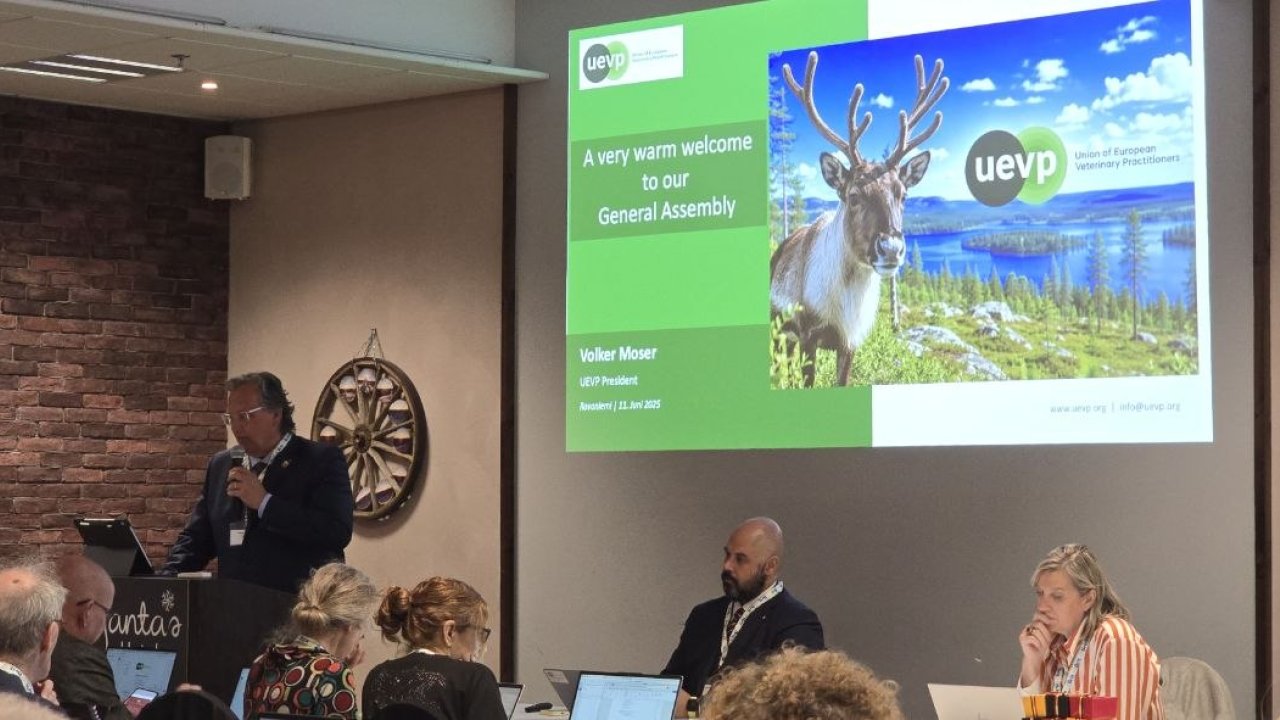
The meeting was attended by Andriy Klietsov, Chairman of the NGO Board “Society of Veterinary Business Owners” (SVBO) moderated the meeting Volker Moser, UEVP President.. For our organization, such discussions are of particular importance because many of the issues raised directly or indirectly affect the independence of veterinary business, the quality of services, and the future of the profession in Ukraine.
The UEVP General Assembly (Union of European Veterinary Practitioners) served as a platform for a strategic discussion on three major topics that are already influencing - or will soon influence - veterinary practice across Europe, including Ukraine.
Corporate Ownership of Veterinary Practices: A Threat to Professional Independence
One of the most acute and emotionally charged topics was the financialization of the veterinary sector and the rapid growth of corporate ownership of veterinary practices. Participants noted with concern that in several European countries the share of veterinarians who own their practices is significantly decreasing.
The situation in France is particularly illustrative: over the past six years, the proportion of veterinarian-owned practices has dropped from nearly 50% to approximately 25%. This is not just statistics - it represents a real shift in the model of veterinary business that carries risks for professional independence, service quality, and animal welfare.
The discussion addressed the landmark December 2024 ruling of the European Court of Justice, which confirmed that the independence of a regulated profession can serve as a legitimate basis for restricting capital ownership by non-veterinarians. Hungary and Austria already have national legislation requiring at least 50% veterinarian ownership for obtaining a practice license. These countries are actively defending the model in which veterinary business remains in the hands of professionals.
Participants highlighted a significant imbalance: corporate structures have far greater financial resources for lobbying their interests than professional veterinary associations. In this regard, it was decided to prepare a unified UEVP position and consider adopting a joint declaration in support of countries that protect the veterinarian-owned practice model. It was noted that similar solidarity support had already helped Croatia during previous legal challenges.
Concerns were also raised about the broader consequences of corporate consolidation: reduced independence of veterinarians, possible changes in medication usage patterns, decreased attractiveness of the profession for young specialists, and risks of price increases and prioritization of “upselling” over actual patient needs. In some countries (particularly the United Kingdom), concentration of ownership in certain regions has already attracted the attention of competition authorities.
Digital Technologies and Artificial Intelligence in Veterinary Medicine

The second major topic was the rapid adoption of digital tools and artificial intelligence. According to 2024 data, approximately 40% of veterinarians in Europe already use AI diagnostics and AI-scribe systems (automated medical record-keeping).
Participants discussed emerging technologies that seemed futuristic just a few years ago: portable low-field MRI, quantum biosensors, and surgical robots (including the smallest devices measuring only 1.5 mm). These technologies have the potential to significantly improve diagnostic accuracy and the quality of surgical interventions.
However, the key message that resonated throughout the assembly was unanimous: digital tools must be developed together with the profession and serve as support for the veterinarian, not as a replacement. It is essential to preserve the human connection with the client and the animal, and to free up the doctor’s time for direct work with the patient rather than for filling out documents. Technology should strengthen, not weaken, the professional role of the veterinarian.
Veterinary Workforce Shortage and Reform of the Accreditation System

The third key topic was the global shortage of veterinarians. According to Federation of Veterinarians of Europe (FVE) data for 2024, a shortage of specialists is observed in almost all European countries. Participants concluded that systemic solutions are needed, rather than isolated measures (such as salary increases or flexible schedules).
Special attention was given to the accreditation system managed by the European Board of Veterinary Specialisation (EBVS). This system is an important international quality benchmark; however, it is currently under serious financial and operational pressure.
The current remuneration for experts conducting visitations (approximately €1,500) was deemed insufficient. Recognition of accreditation at the national level remains uneven. This creates risks for the quality of specialist training and for trust in the system as a whole.
Three directions for reform were proposed:
- ensuring fair remuneration and proper recognition for experts conducting visitations;
- creating a new multi-source funding model involving partners (FVE, universities, professional associations, and others);
- holding a coordination roundtable in 2026 to review and optimize the visitation model.
Decisions and Next Steps of UEVP

As a result of the discussions, the assembly participants adopted several concrete decisions:
- Prepare and put to a vote a formal declaration on the regulation of veterinary practice ownership to support member countries that protect the professional model.
- Launch a consultation process regarding the interpretation of the Services Directive (particularly the French interpretation).
- Establish a working group to reform EBVS visitation teams, focusing on fair remuneration and professional recognition of experts.
- Launch a dedicated working group for a comprehensive evaluation and restructuring of the current visitation model.
These decisions demonstrate that the European veterinary community is ready to actively defend professional values and seek a balance between development and the preservation of professional independence.
Why These Discussions Matter for Ukraine
Issues of corporate ownership of veterinary practices, protection of professional independence, implementation of digital technologies, and accreditation reform directly affect Ukrainian veterinary business.
In the context of European integration and potential changes in national legislation, it is critically important for Ukraine to understand European approaches and the risks that colleagues in other countries have already encountered. Preserving the possibility for veterinarians to own their practices, protection from excessive pressure by corporate structures, the sensible implementation of artificial intelligence as a tool to support the doctor rather than replace them, and ensuring high-quality training of specialists — these are the issues that will shape the development of the sector in the coming years.
The NGO “Society of Veterinary Business Owners” (SVBO) systematically monitors European discussions and participates in them so that Ukrainian veterinarians receive up-to-date information and can respond to challenges in a timely manner. We believe that the Ukrainian veterinary community should not be a passive observer but an active participant in shaping European standards and practices.
Join SVBO - Stay Informed and Protected
Discussions at the European level show that the future of veterinary business is being decided today. Those who do not follow these processes risk finding themselves at a disadvantage when changes reach Ukrainian legislation.
The NGO Society of Veterinary Business Owners (SVBO) is the only organization in Ukraine that consistently represents the interests of veterinary practice owners at both national and European levels. We do not just inform — we protect, advocate, and create tools for development.
Membership in SVBO gives you:
- access to up-to-date information on European trends and potential risks for your business;
- real legal protection and the possibility of mediation in complex situations;
- the opportunity to influence legislative initiatives through advocacy work;
- participation in grant programs and international projects;
- a strong professional community of business owners facing similar challenges;
- support in implementing modern tools (including digital technologies) without losing professional independence.
If you are a veterinary practice owner, chief veterinarian, or clinic manager - join the Society of Veterinary Business Owners. Together we can protect the model of independent veterinary business, influence the rules of the game, and ensure the high-quality development of the profession in Ukraine.
Contacts for membership and cooperation:
- Official website: uacbbc.org
- Telegram channel: t.me/uacbbc
- Email: uacbbc@gmail.com
We will continue to inform you about key European discussions, decisions, and opportunities affecting veterinary practice in Ukraine.
Nataliia Klietsova
Public Relations Manager
Society of Veterinary Business Owners (SVBO)
(on a voluntary basis)